

I present the inaugural launch of the Tory political compass:
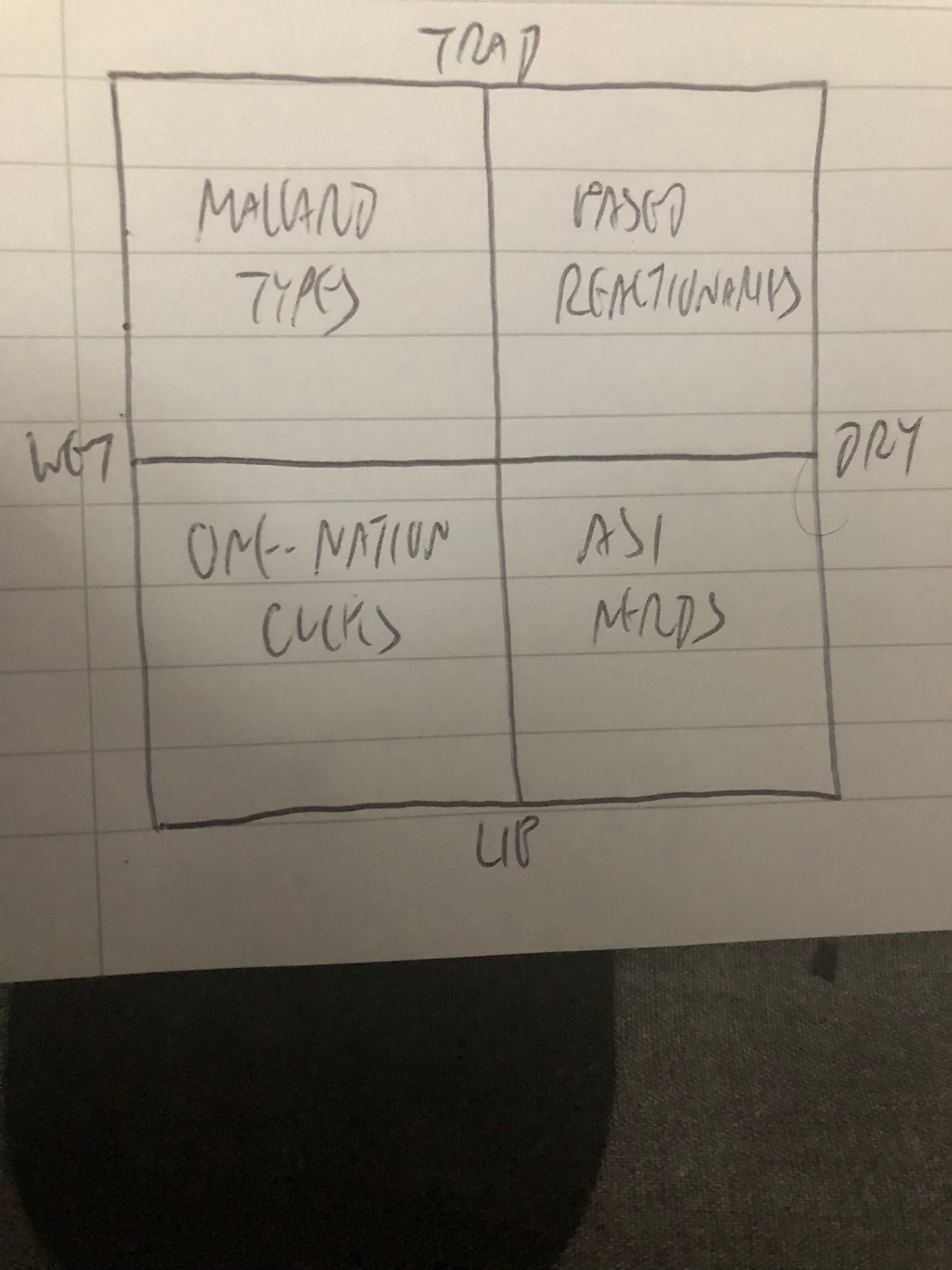
As is evident, the concept is rather self-explanatory, so requires little in the way of analysis. “Wet” refers to economic leftists (in relative terms) within the party in internal Tory discourse, whilst “dry” is code for Thatcherite or economic libertarian. In addition, social or cultural stances can be represented on the vertical axis.[1] Hence, four quadrants arise. Bottom-left is dominant (as with the OG political compass test regarding most respondees) amongst MPs. Bottom-right is where the neoliberal nerds and policy wonks in the multiple think tanks (ASI, IEA, etc - the British equivalent to the Cato Institute) reside. Top right is dominant amongst the membership. Top left, the smallest quadrant in terms of representation in the party, seems to have gained traction amongst those associated with the fresh and upcoming Mallard publication.
Much of the division within the party, hence the turmoil and chaos of the last decade, can be analysed via the lens of this compass. In particular, the striking divergence between the parliamentary party vs the membership becomes apparent. MPs are largely concentrated in the bottom-left, albeit with dry quadrants forming a significant minority of the backbenches, and the top-left gaining in traction given the fresh 2019 intake from the “Red Wall”. On the other hand, the party membership is overwhelmingly spread across the other three quadrants.
In many respects, Europe was a proxy battle between the bottom-left vs the other segments. To characterise the Brexit divisions as a left vs right, or culture war issue (as most commentators do), neglects the existence of the neoliberal types (whom mostly, although not uniformly, voted leave) and the Mallard phenomenon (a small yet important faction, given the recent electoral success with working-class “Red Wall” voters). Moreover, framing Europe as a battle between the one nationers vs the others highlights the rationale for the sheer intensity of the debate; for too long the leading one-nation cuck faction neglected the rest of the party. As history demonstrates, minority rule can indeed be a sustainable equilibrium, yet a rather unstable one, prone to conflict and polarisation - hence the volatility in British politics within the last decade. Indeed, it was reminiscing Brexit that inspired the formation of this invaluable, creative tool.
One can think of Brexit as an uprising of the grassroots against the one nation establishment; if the demands for a referendum were not satisfied, three out of four quadrants were at risk of being siphoned off to UKIP where the majority would no longer be neglected, and severely damaging the Conservatives in the process. If not an existential threat to the party, this would certainly have cost them victory (hence all the majorities) at the 2015 election. Discontent with the one nation hegemony amongst the leadership contributed to the intensity of the obsession regarding Europe (arguably an otherwise trivial matter), which was a proxy fight signalling far deeper disparities. As such, whilst Brexit may well be over as the current thing, the fundamentals that led to this monumental event remain - this time manifesting itself in a somewhat stochastic assortment of issues (dissatisfaction with Boris Johnson governing as a one nation cuck despite earlier hopes, the “culture war”, and so on). Once again, the divergence between the leadership vs the majority of the party has caused further chaos.
Given this tool, and what we know about the composition of the membership and the parliamentary party alike, we can reason from first principles the likely outcome of the contest. First of all, it is imperative to plot each contender on this compass[2]:
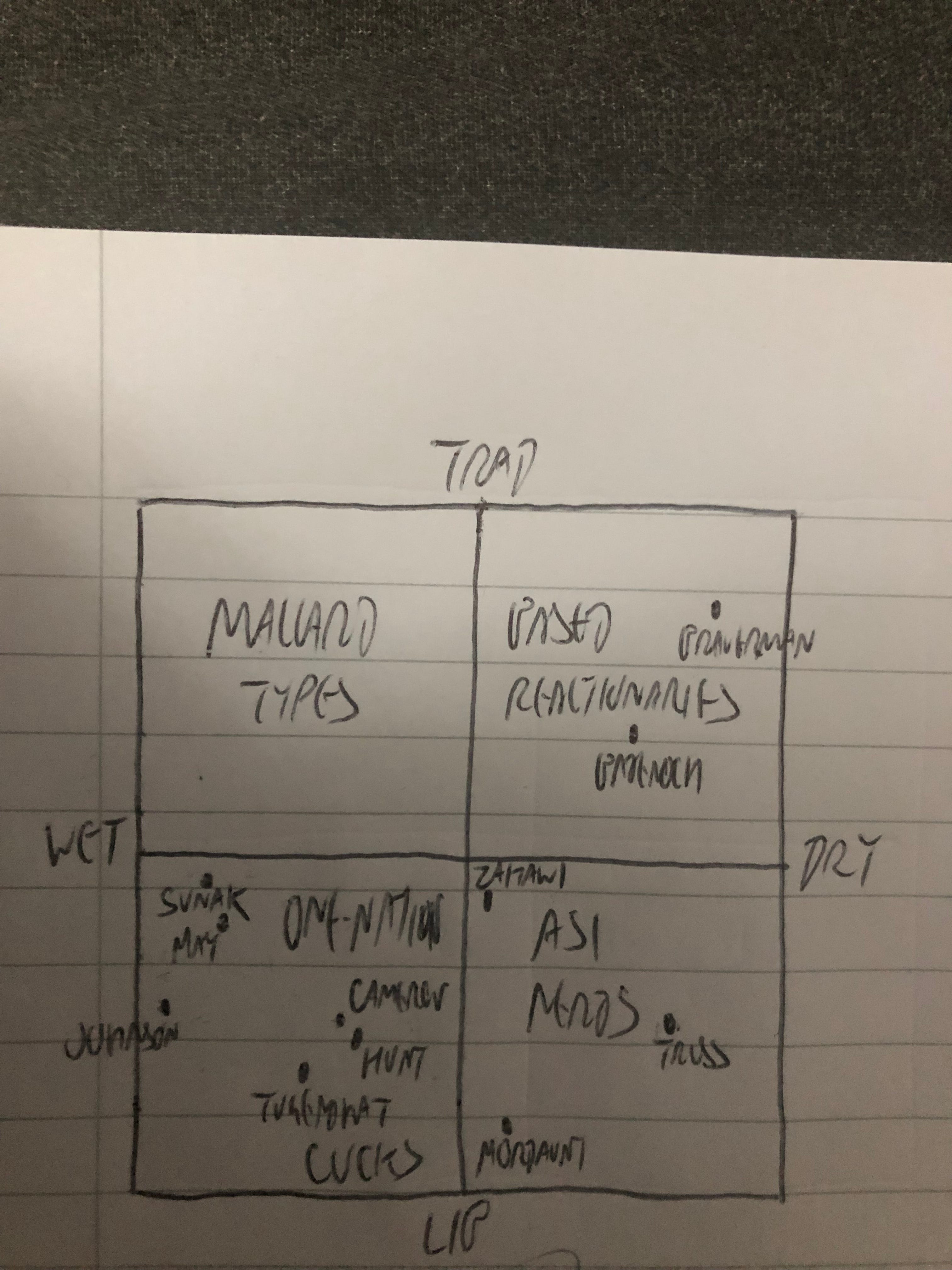
We already know one of the likely two contenders in the final stage. Sunak is the clear frontrunner so far amongst MPs, as might be expected given the dominance of the one nation cucks. So now we can eliminate the low-hanging fruit here. Hunt and Tugendhat are both far too wet to attract the support of the dry minority amongst MPs, so will be forced to drop out. Braverman is on the rightmost fringe of the parliamentary party, hence will not obtain enough support.
As a result, the four candidates with a chance at entering the final round are Zahawi, Mordaunt, Badenoch, and Truss.
Zahawi is the closest to the centre here, yet may be perceived as insufficiently dry; he has a chance but the odds are low.
Mordaunt, already facing controversy over her previous support for “trans rights”, is far too liberal. Nonetheless, she has an early lead for second place amongst MP endorsements, and appears to be popular in a series of recent ConHome polls. I would be foolish given those statistics to write her off, yet I cannot see her winning the more socially-conservative oriented MPs (most dry MPs are in top-right).
This now leaves us with Badenoch and Truss. Badenoch was successful in forming an impressive launch to her campaign so far, with her pledges to counter the postmodernist pandemic, uphold the core Enlightenment value of free speech, and decrying the government’s net-zero target as “economic disarmament”. If I had a vote, she would be my choice. Moreover, she is well placed to win the dry vote. However, it is clear that the focus of her campaign is on “culture war” issues. In our stagflationary crisis, with a bloodthirsty maniac closer to us than California is to New York, is such a focus really that wise? Truss on the other hand is not only more suitably positioned to win over the odd MP backing Hunt or Tugendhat, but also has a clear track record on handling geopolitical affairs. A much wider portfolio of experience at the heights of government, with a reputation for competence, certainly helps too. Simply put, Truss has much broader appeal, so she has the edge over Badenoch.
Now here comes the final round. In our hypothetical scenario discussed here, Sunak vies with Truss for the vote of the membership[3]. Sunak being the wet, establishment, continuity candidate will definitely face an upward struggle here. Once again, the one nation cucks vs the other quadrant divide is by far the most important phenomenon within Tory party politics. To me, it is simply a no-brainer that the odds are in Truss’ favour here.
My prediction is now on record. In Truss we trust! Truss or bust, I guess…
There is stark heterogeneity in many social attitudes here. For instance, a classical liberal whom is pro-choice and supportive of gay marriage, can be rather distinct from a postmodernist whom insists on pronouns as a litmus test. One can be feminist, yet advocate for tighter restrictions on immigration, and be opposed to globalism. Yet there exists a strong correlation between these viewpoints, hence for tractability I have streamlined them down to one axis (*linear algebra is not my strong point*).
I have also included the previous three PMs, to add some perspective.
There will almost certainly be a contest in the final round, and not simply a stitch-up as in May’s case. Given how crowded the field is, if Truss steps down, one of the other contenders would almost certainly not.