
What the hell is going on in Britain?

To say that this has been a tumultuous week in British politics is a grave understatement. Twitter feeds worldwide are swiftly becoming saturated with resignation letters and the ensuing gossip. Yet the intricacies and eccentricies of our recent political drama can often seem baffling to natives alike, let alone outsiders. So to the benefit of my readers and subscribers across the pond, this light-hearted Q&A is the breakdown to follow!
So tell me about this Boris Johnson guy?
A clown who has been in office as PM since the summer of 2019 (I recall the exact moment vividly - I was in Amsterdam at the time…). Having risen to prominence as the previous mayor of London, then a crucial figurehead of the campaign for Brexit, he began his first term by changing an unstable minority administration into a thumping 80-seat majority. Afterwards, he implemented Brexit (finally!) and oversaw our response to the pandemic. A charismatic, polarising figure widely regarded as a “populist” (Brexit was our poundshop substitute for visceral American culture wars), he generally was popular - which other Conservative could win over the Labour-voting working class?[1]
If this guy is such a winner, then why has he resigned?
Many months of scandals, and a party that turned sour (and no, not just a bad hangover either!). Plus no policies to show for an 80-seat majority aside from unpopular tax rises and Covid lockdowns. Overall, he has always been regarded as an unserious, deceitful buffoon and an embarrassment - those qualities ultimately stabbed him in the back.
To the benefit of my American followers, these lockdowns did not simply constitute school closures or the odd bar closing. We were placed until literal house arrest. Yes, you heard that right. HOUSE ARREST! You were allowed out of your home once a day for essentials and exercise. Only “key workers” (whatever the state decided, i.e. central planning) were allowed out of their house to work. This point is vital to stress, as we (regardless of whether you supported the lockdowns or not) made immense sacrifices in this period. Compliance and morale was almost uniform.
Sounds like a living nightmare. The party sounds fun though?
Except these parties were held within those dire lockdowns, lockdowns of his own creation, whilst the rest of the country endured house arrest. This scandal, known as “Partygate” dragged on for many months, boring much of the country to sleep. A topic being the current thing is one thing, holding a monopoly over political discourse is another. I posted this at the time this occurred.
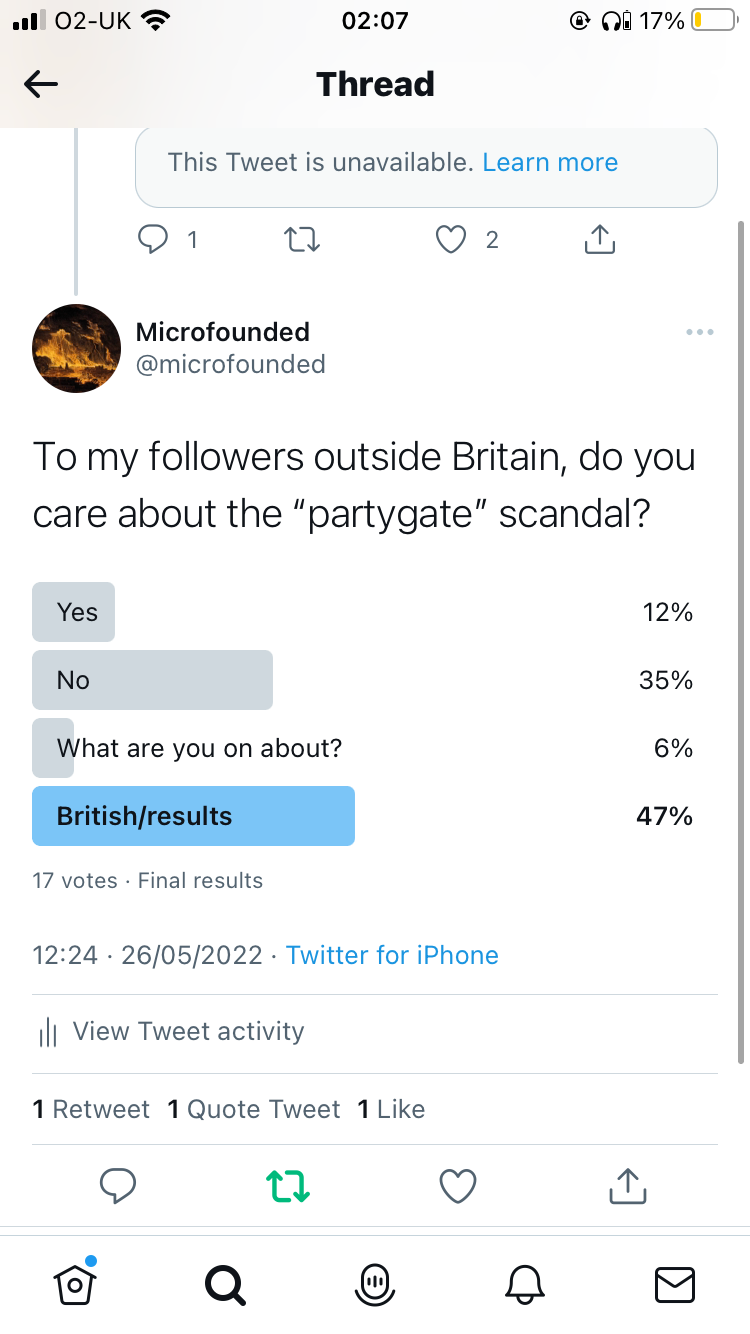
Eventually however, these series of events culminated in Boris Johnson being the first ever PM to be charged by the police with breaking the law in office; a law of his own creation. Incurring a fine appeared to be the least painful of the punishments, as not long after he faced a vote of confidence last month (the British equivalent to impeachment proceedings). He narrowly survived, yet this would form the backdrop against his later downfall.
Ok, that was poor form, but there has got to be more than this?
Bingo! Last week it had emerged that his (now former) Deputy Chief Whip, Chris Pincher, is facing a plethora of sexual harassment allegations. Whilst Johnson initially denied any knowledge of these, it was later admitted that he was aware of them before appointing Pincher. Putting aside whether these serious allegations are true (we all know from #MeToo feminist psychopaths the immense danger of public exorcisms of this nature without due process), this is just a typical example of the sheer quantity of lies at play. Yes, every politician engages in deceit, but the scale at which Johnson lies is unprecedented. Just recently he was found to have misled parliament over “Partygate”.
Add to this two catastrophic by-election defeats on the SAME DAY: one in a rock-solid safe Conservative seat to the Liberal Democrats (a third-party, basically Democrats), and the other in a key swing seat to Labour.[2] To put the sheer magnitude of the bloodbath into perspective, losing the former seat is tantamount to the Republicans losing Wyoming.
Obviously, you cannot run a government with a scandal occurring every couple of weeks (literally - I only have time to touch the surface here, but there is an entire list of them on his Wikipedia page).
Obviously, that signals a remarkably dire grasp of affairs and astonishing incompetence.
Obviously, the position of a once insurmountable victor of a landslide wave is untenable.
Hence, on Tuesday, two of his most prominent ministers resigned from his administration. Rishi Sunak the chancellor (read: Treasury secretary, or minister of finance), and the subject of plentiful speculation regarding prime-ministerial ambition, handed in his notice alongside Sajid Javid, who oversees the NHS. Not long afterwards, in a process similar to a Jenga tower falling, about a third of Johnson’s entire administration followed. Assuming that everyone who voted against him in the confidence vote was not in his administration as a minister (so a backbencher, in British jargon), it was now mathematically impossible for Johnson to fill all the roles needed to govern. He has little political support. His leadership is over.
So what happens now?
No one knows. Not me, nor Johnson himself, nor anyone. Now there will be a primary contest to determine the next Conservative Party leader (and hence PM), yet this could take months. For now, there is no clear frontrunner, and Johnson still plans to stay in office until the next leader is chosen. There are already rumours of attempts to dispose him beforehand - who wants deadwood to foster for months? Maybe the shambles that is British politics is not over yet…
Labour is the main left-of-centre party, with the Conservatives being largely equivalent to moderate Democrats (with some actually conservative factions).
Tiverton and Honiton, and Wakefield - for the psephological geeks out there.