
Testing nerdy ChatGPT-5.1
How tax rates interact with search activity

After setting the personality of my agent to nerdy, I fed this question to the updated chatbot. I often experience “shower thoughts” on complex topics of economic analysis such as this. In the previous era, progress on such questions would likely require an academic paper, and extensive time preparing an internally consistent model from scratch. Now, I can just feed preliminary thoughts into the LLM, and out comes an economic model from scratch! Anyone who doubts the capabilities of AI is clearly oblivious to the fact that it came produce academic journal-level work in seconds.
The question in turn was this:
On the extensive and intensive margins, my elasticity of labour supply produces a downward response to labour hours in relation to an increase in tax rates. However, it also induces me to invest more in search: to find a higher paying job. How can I model my income and substitution effects? Is it rational for me to hold such preferences?
Here is a screenshot for part 1
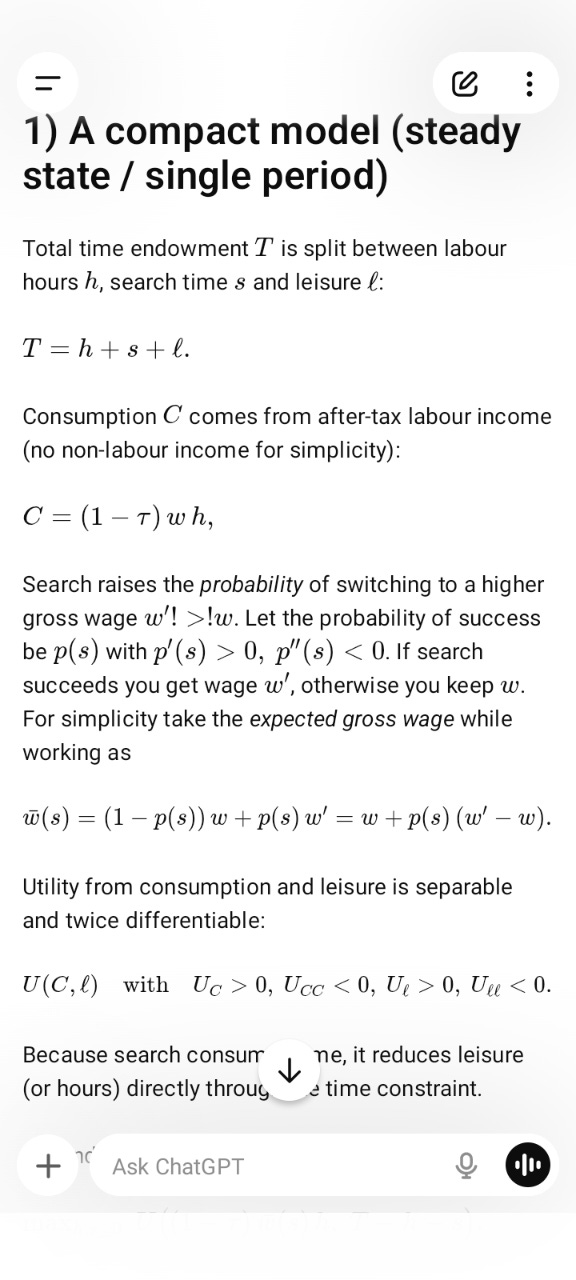
Here, the model seems to treat the search decision to move to an occupation with a higher wage as discrete, with a discrete probability of success. This is a genuinely innovative approach, and one which is in tension with the canonical technique of modelling at the margin. I am unsure what to make of this.
Okay, now we’re back to convention:

This is a summary of the results. A higher tax rate will reduce my labour supply under the standard assumption that the substitution effect outweighs the income effect, however that income effect may be powerful enough to incentivise extra search. The latter holds under the following conditions:

On point 3 in particular, this may work for fixed search costs, but gets more complicated if search costs are endogenous. In that case, strictly speaking, it is inaccurate to describe this as a “decreasing monetary cost”, although as the model clarifies this in the next sentence, I may just be overly pedantic here. Likewise, at the end, the model asks whether I would like to incorporate search costs endogenously.
Another trivial pet peeve: the term “psychic cost” is somewhat confusing, until you realise that it is simply referring to the time constraint. Perhaps nerdy ChatGPT-5.1 could work on its nerdy tone (you would think a nerdy bot would refer to the time constraint explicitly) - otherwise I have no problems with these results.