

Recently I've been on a campaign of some sorts against Carte D'or. During the heatwave, I purchased a tub of Carte D'or vanilla expecting an “affordable premium” product. Out of curiosity (well boredom!), I turned over to read the ingredients. Beyond ice cream having some vague link to dairy and cream, I had no idea of exactly how it’s made. Immediately, “reconstituted skimmed milk”, “glucose syrup”, and “coconut fat” struck out to me, alongside the typical assortment of stabilisers (generally gums for ice cream), emulsifiers, and preservatives.
I had no idea what reconstituted skimmed milk was, nor whether this was how ice cream is supposed to be made. After speaking to ChatGPT 5.5 on this, it become obvious that the notion this can be called “ice cream” is fiercely contested. America, yes America of all places, requires a minimum 10% dairy fat for a product to be labelled “ice cream”1. Whatever the hell I was eating, many people would charitably consider it only a vague reference or aspiration to the idea of ice cream at best. The fact this was from Carte D'or makes this a borderline scam. You expect luxury from them; not a product akin to that yellow supermarket-owned crap. Yet I paid premium prices to buy the latter!
What surprised me even more then was that this formula of vegetable fats + milk powder is the dominant equilibrium for British ice cream. Most brands you can think of: Magnum, Walls, even luxury and supposedly “artisan” products, are this industrial sugar foam. As for local, dairy produce, they are pumping the cream full of overrun. Even sorbets from the local farm have that unmistakable lattice of air bubbles that you can't unsee once you learn where those bucolic creases in ice cream come from.
Therefore, I'm tending towards the idea that ice cream is a food specifically designed for the gastronomic equivalent of philistines. This market equilibrium works not just because of a “race to the bottom”, but because you get uninformed and undemanding customers that seek a sweet treat and don't enquire further. That may work for most, but it doesn't work for me!
Yet such is reflective of how Brits unfortunately approach food in general. It's also reflective of price-level increases, which in a monopolistic competition setting can translate into reduced markups via lower quality or quantity (“shrinkflation”) as well as price rises. These farmers aren't whipping their produce full of overrun for the sake of it, but are genuinely feeling the cost-push pressures. But what if we can use this similar economic reasoning to pick our optimal bundle of eateries2?
This is the premise behind Tyler Cowen's An Economist Gets Lunch. Opt for combinations rather than stand-alone ingredients, informed consumers and suppliers (often immigrant family-run restaurants serving their ethnic cuisine in a hub for their community), avoid places of heavy drinking and vibes-based socialisation, and so on.
To an extent, this guidance has been codified in the chatbots. Ask them “where would Tyler Cowen like to eat in Bradford” and you get these results:
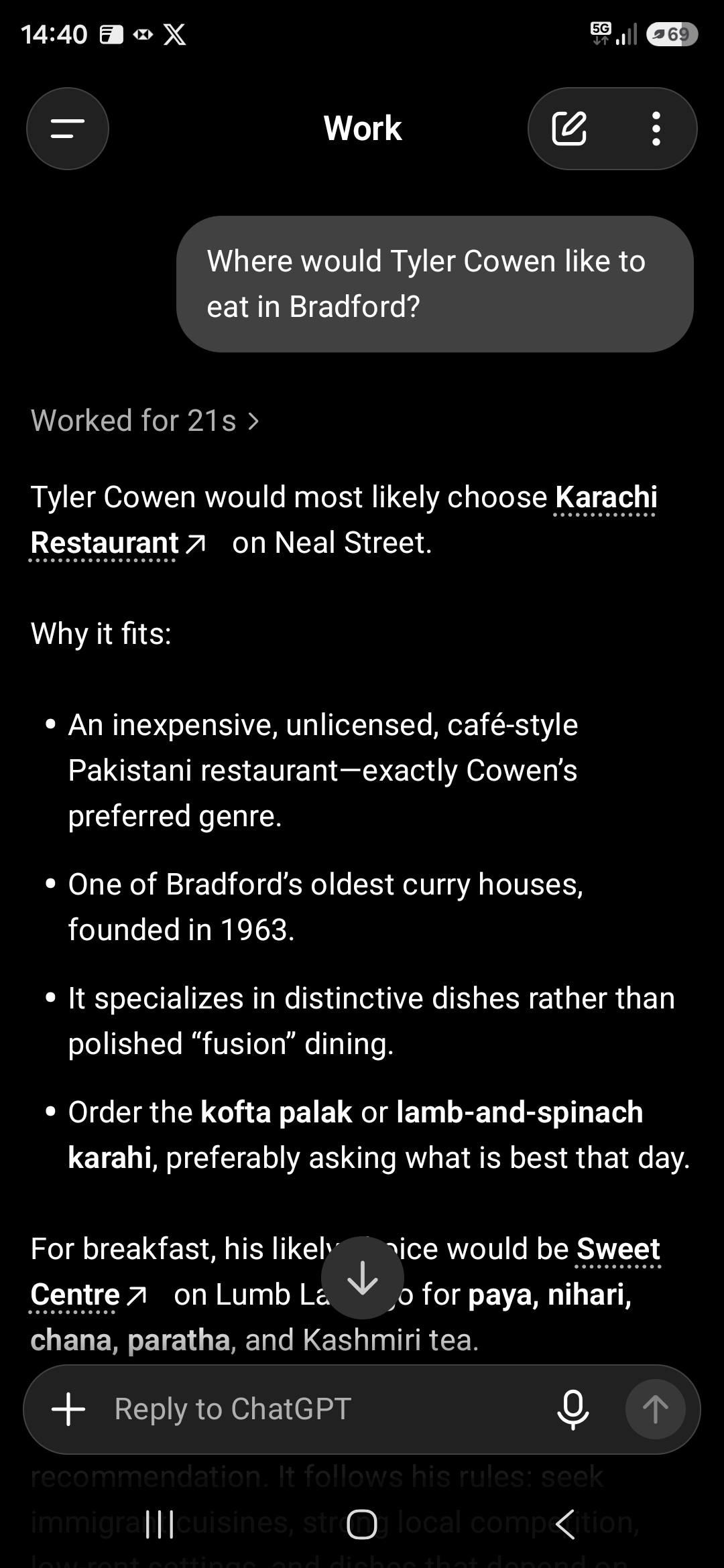
Mirrored by Fable too. I also think Fable is right in its Cowenite advice to avoid MyLahore (a British fusion place where more patrons eat burgers and chips than authentic dishes from the motherland), and Mumtaz (now a chain, using its premade processed sauces for its curries). The difference between the Sweet Centre (that when you order a korma, uses fresh coconut and cream to make the sauce from scratch) vs Mumtaz, International, or even Akbars, is noticeable. Of course the latter do curries to a much higher standard than most of Britain, yet this is a low bar.
However, the chatbots miss the fact that some of the best places to eat in Bradford aren't curry houses at all. We have a burgeoning first-generation African population, and with it new places to eat. African restaurants tend to be incredibly scruffy on the outside, in areas you'd otherwise avoid, and so most just walk past hardly noticing that place does food. Yet these places are often better than the curry houses these days. In neighbouring Leeds, there is an entire hub of Ethiopian, Eritrean, Somalian, and Sudanese places to choose from. All of which are on the main roads, yet not heard of by anyone. We also do Jamaican, of which I am third-generation, and I can confirm the food approaches the real thing. Looks like the gold treasure is often buried right under your noses!
Today, I had Tacos el Pastor (less than £10 by the way, whilst the burrito discourse is still ongoing!) with an achiote rub. I also had roast lamb and mash. The latter sounds like a standard roast, yet the gravy was replaced with Mole Negra that had me licking the plate (well with a knife)! A month ago I also bought a tamale for £5. None of these dishes are easy to find in Britain (outside London3) at all. Still not convinced the venue is authentic: I was greeted with the Virgin of Guadalupe (hence the name), rather than a sombrero, with additional indigenous Oaxacan art imported directly from Mexico.
Compare and contrast to the usual Mexican-themed places, which are often fusion based and bars where the food is an add-on to the boozy socialisation rather than the main focal point in itself. Then of course you have the usual chains: Taco Bell is about ten minutes down the road, and in Britain this chain is still a novelty. Unfortunately, the latter will get far more customers than the former. This Cowenite philosophy to food4 is too adventurous to most. Yet for those of us that seek quality, it's there if you look hard for it, and don't just assume it as given. Most people have simply retained the palates they had as kids5.
Surprisingly, the UK excels in Turkish cuisine. The best restaurant in Ormskirk, a somewhat remote market town (albeit gentrifying with affluent professionals and families working in nearby Merseyside, and students from the new university) where I used to live, is a Turkish grill. The Ocakbaşı format works well here, as this is essentially the higher-end version of the greasy döner kebab market (cross-subsidised by our pub culture)6. Persian cuisine arguably fits the same profile, and on this front Bradford is particularly strong.
Pakistani food is probably the best you'll get outside Pakistan. Maghaz, nihari, paya - all are done to exceptionally high quality. Indeed, Maghaz is probably one of my favourite dishes. Outside of the mill towns though, British curry houses are typically awful. The same sauce, korma to vindaloo, just at different spice levels, and probably store bought too.
In Bradford, I currently place the Sweet Centre7 as having the best korma, Jinnah for the best maghaz (pronounced magz), and the Signature Mall for the best nihari. Punjab Sweet House is the place to go for burfi, gulab jamun, et al. Lala's does the best butter chicken, and is strong in the more authentic dishes too. Rahmath is the place to go for dosas and Keralan beef or seafood curries. Akbars flagship also deserves a mention, and I still occasionally visit, yet the Sweet Centre tops it in the freshness of the pastes, though nonetheless Akbars is amongst the best curry houses of all time. International is worth visiting once, but they're on the expensive side. Mumtaz (as I mentioned) is not worth it as it's bland and mediocre.
MyLahore serves watered-down karahis, and even the grilled paneer has little flavour. Avoid like the plague! It went downhill ever since it became a chain. Chains are not necessarily bad, yet you have to have the original family within the core of the production process overseeing the cooking and recipes, and it works only insofar as the recipes are scalable whilst preserving quality. For curries, it's possible, so long as it's not batch-cooked then reheated. Unfortunately the temptation to pursue this route is far too strong given the cheap costs.
Manchester Chinatown is full to the brim with the “authentic” cooking, such as DanDan noodles from Chengdu. Leeds has venues for Shandong and Hunan cooking, with the latter serving one of the best meals I've ever had (Mao's pork belly)! Yes you can get good salt and pepper meals8, yet British Chinese is always strictly dominated by the cooking of the homeland9. Chinese food, done properly, is by far the best culinary culture worldwide, and it doesn't even come close (albeit some dishes from the Indian subcontinent make for excellent competition). Korean barbecue is another culinary highlight of Manchester.
In any major British city, the Vietnamese offerings are also generally strong. Vietnamese cuisine is designed for a casual or social affair that you drop into whilst doing your errands in the city centre, hence perhaps inverts Tyler's advice on food somewhat10. Anything on the menu: banh xeo, banh mi, pho - it's guaranteed to be good, and pairs well with sriracha, hoisin, or squid sauces. In Bradford, TongThai does excellent and authentic Thai with highly enthusiastic service.
N.B. IPA is good for pronunciation. A good habit I carried from my conlanging days.
One of my favourite treats are Little Moons mochi balls, marketed as vegan ice cream. The UK regulatory change in 2015 was precisely so that vegan products could market themselves as ice cream. Here, the base is coconut milk (heavy with coconut extract, giving a rich smooth texture actually resembling ice cream) rather than fat. They've not pumped the mochi with heavy overrun (probably less than 10%), albeit Magnum is good on this score at least. I think what's fascinating is that this felt like eating a dairy brand, which tells you how far much commercial ice cream has fallen. The texture is pretty much equivalent to a Magnum. I reckon this is probably karma for us meat eaters.
I use this term on purpose, as I'm not just discussing sit-down restaurants in the content that follows, but food stalls and more informal cafés too.
Even in London, according to Claude, Mole is typically served in an £100+ tasting menu (given the ingredient list). I was basically eating Michellin-quality food at Northern prices!
Another area where this blog departs is that African places tend to combine the socialisation aspect, drinking, and good food very well, as do Vietnamese eateries (minus the drinking). The difference is that on the outside, these places are often in a worse state than the ubiquitous derelict mills of the North.
Much to the chagrin of my parents, I always insisted on eating from the adult menu, and always picked the (more expensive) authentic dishes as opposed to chicken nuggets or something. I ate my first full chilli pepper at six years old.
In Bradford, I can get one of these greasy kebab takeouts that do Fatayer, yet I suspect this is generally the exception to the rule for most of Britain.
It's on the notorious Lumb Lane, that I used to avoid given its reputation for crime (albeit much of which is downstream of the prostitution, which I'm sanguine about). Today it's far too Islamic for its past legacy to hold.
Albeit gobi manchurian gets the flavour better with a similar texture.
The exception is if you cannot handle spice, as these also make most Indian curries seem mild in comparison.
The one on rents, albeit Vietnamese places tend to be in rather peripheral areas of the city centre as opposed to right in the commercial hubs, so perhaps they're off the beaten path enough to matter. Manchester Chinatown, technically in the centre, does feel like a distinct neighborhood altogether. Outside of the Lower Manhattan Chinatown, this is the best Chinatown that I've visited (albeit I have fond memories of the off-menu LSE rice in London Chinatown).