

On the right, there is the resurgence of reactionary nativism. On the left, a pivot to a nostalgic vision of a Britain where price controls were the norm. In a country with thousands detained for “grossly offensive” speech crimes, the spectre of Magna Carta rights to due process and presumption of innocence being undermined via jury trials being threatened, and where schools routinely suspend their pupils for thought crime, the necessity of such a movement has never been more imminent.
Therefore, I have been thinking deeply on the prospects for classical liberal ideals here, and how best to maximise their influence. Along with many others of a libertarian leaning, as best exemplified via the infamous neoreactionary ecosphere, I had previously thought that democracy was a historical mistake, and should be abandoned. This line of reasoning, it turns out, is a mistake, and the more typical liberal consensus here is in fact correct.
You can skip the last two paragraphs of section I if you are unfamilar with the economics, otherwise here I explain why. A good liberal changes his mind with additional evidence, and so I have now been persuaded by my fellow liberals on what could be one of the defining battles of our lifetime: the fight to protect democracy.
I. Democracies maximise welfare
To see why, consider the growth performance of advanced Western economies after WWII. Countries undergoing more catch-up growth saw more of it. Italy, Japan, Austria, France, and Germany with its renowned Wirtschaftswunder. Britain and the US, closer to the frontier, grew at slower rates. All in the former category saw econonic miracles occur within a generation, despite variation in policy and economic institutions leaning in a statist direction.
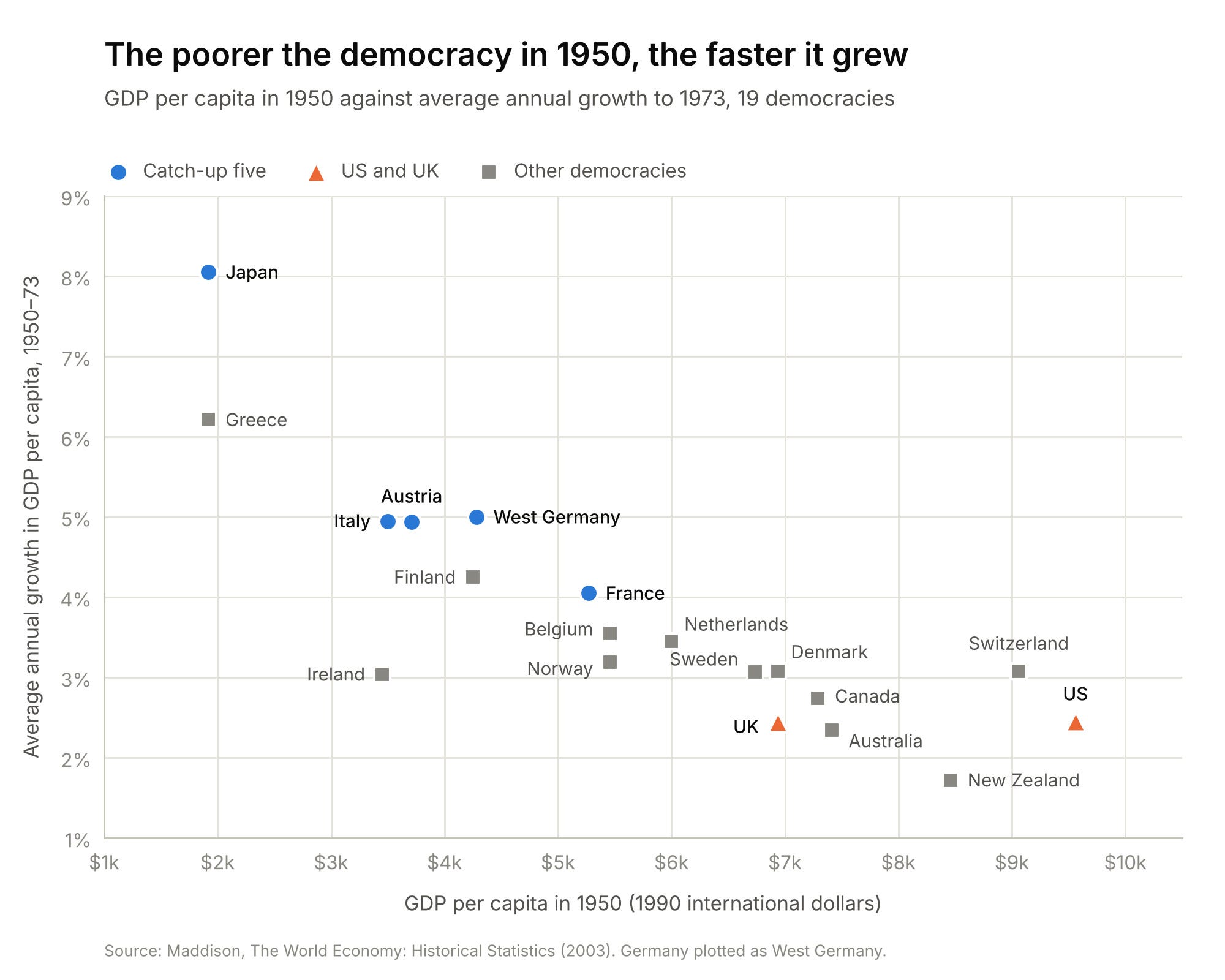
Compare and contrast with Spain and Portugal. Whilst these experienced economic miracles of their own, they arose much later, in large part due to the policies of their respective dictatorships promoting autarky. Indeed, starvation was ubiquitous in the post-war years for Spain. Plus note that the Franco and Salazar regimes are generally considered amongst libertarians to be amongst the better autocracies too, yet quite clearly the evidence points towards them being a barrier to growth. The Spanish miracle was relatively modest compared to that in democratic nations anyhow.
The mechanism seems to be the one well-documented, that democracies can fuck up a lot (as France is doing today) yet often reverse course or mitigate before the damage is too late, hence impose much less variance on outcomes than autocracies (despite the best seeing unusually high levels of progress). Schumpeter was right in decentralised institutions promoting innovation via creative destruction and spontaneous order, and this is often what we see in democracies compared to stale and stagnant autocracy.
Yes, democratisation is linked to greater redistribution. Most of this in the West appears to be social insurance against life's most common shocks though: old age, illness, disability, and unemployment. Conceptually, this is different from inequality-aversion per se. Social insurance can be justified on risk aversion grounds as well as reducing inequality, yet both CRRA preferences and inequality aversion would show up as a curvature in an Atkinson-style social welfare function. Nonetheless, it seems reasonable that growth is not all people care about, and that as their incomes (and consumption and leisure) rise, so does their desired consumption of insurance.
This can be done via private markets, yet classic information asymmetry problems with heterogeneous financial frictions generate separating equilibria, so some would pay higher rates in private insurance markets relative to social insurance systems. Pooling equilibria will generate moral hazard, and taxes will be distortionary, and possibly suboptimal depending on elasticities, social preferences, if they differ from ideal Lindahl prices, and so on. Moreover, in many OLG models, if population growth exceeds interest rates, then the standard PAYG public pension systems are Pareto improving. In summary, welfare states could be normal or luxury goods, so democracies expanding them as they grow would be a correct aggregation of preferences, and hence be optimal.
II. Libertarian autocracy relies on the illusion of a philosopher king
At this point, my thought was yes, but social planners will not have accurate information on the relevant parameter values, and are not benevolent anyhow. Hence policymakers should be biased towards decentralised information aggregation via markets and non-state interactions, and so an autocratic nightwatchman would therefore be superior to the liberal democracies we see today.
Yet this somewhat Hayekian perspective works the other way too. If social planners are not benevolent but a set of rational self-maximising regulators, lobbyists, politicians, lawyers, bureaucrats, and other interest groups, then a libertarian autocracy would never stay libertarian and such elites would abuse this concentration of power. They would hold private information, exploit that, so lead to worse aggregation outcomes even if Arrow shows aggregation in democracies can never be consistent.
These dynamics apply just as much to “enlightened” technocratic experts too, as the UK House of Lords and the European Commission can attest. The former, meant to grant experts representation in the legislature, has decayed into a trophy for party donors and a retirement home for politicians. The latter is drawing up new border rules (ETIAS) so detached from the public view that no one even knows exactly what the framework is, let alone what the implications are. This is the best example for why the usual arguments on democratic accountability and debate apply, otherwise you risk legal uncertainty.
Not only is this public choice 101, but is the precise argument in favour of democracy that many liberals (including ordoliberals for concentrations of private power, and the downstream effects this entails for institutions) espouse. Even the good autocracies are censorious, and abuse their powers for their own gain1. Meanwhile, the fact that the US constitution and separation of powers appears to be constraining Trump is a vindication of the normie liberal argument on democratic accountability and checks, despite the decay in shared norms. The rule of law acts as a credible commitment to elites not to expropriate property for their own gain, or arbitrarily arrest their competitors (business, political, or otherwise).
III. Why a nightwatchman state will never happen
All of the above points probably explain why a nightwatchman state has never occured at any point in history, except perhaps failed African states. For a nightwatchman to have the state capacity to enforce the contracts necessary for markets to thrive, or the non-aggression principle, it will need the fiscal capacity to tax, which means the ability to run welfare states. Either this occurs with democratisation, or repression (implying eventual elite capture by rent-seekers) is necessary.
Such a minarchist vision was popularised by Nozick2 via (in my view) an excessive reliance on rigid Kantian imperatives anyhow. Liberals appear split on deontological natural-rights based (Nozick, Locke, Kant, etc) vs utilitarian and consequentialist approaches to human flourishing and liberty. Nonetheless, the classical liberal tradition goes beyond and long predates Ron-Paul style dogma imported from across the Atlantic. Ordoliberals helped build Germany’s social market economy. Friedman is reviled for seeking to reform rather than abolish central-banking. Smith supported public schooling, and even Hayek (aligned with the ordoliberal school) was in favour of some social protections. Today's highly Americanised stereotype of libertarianism is simply not an accurate representation of our entire beliefs.
IV. On why you should not depend on first-principles
I also think I relied too heavily on first-priciples reasoning, neglecting the mulitiplicity and path-dependent nature of history. This is an issue for many terminally-online, whom are younger so more reliant on first-principles or domain knowledge, yet deficient in the tacit accumulated knowledge on life, society and its norms we call “wisdom”. Outcomes are therefore state-contingent. Yes, Pinochet might have been good for Chile, and Lee Kuan Yew good for Singapore. Yet the Wirtschaftswunder was in part a result of ordoliberal policymakers compromising with the unions. Germany's social market economy endured a lot more state investment, union power, and social protections than most classical liberals or libertarians may like. This was probably necessary to prevent it going communist, keep it aligned to the west, or its economy being wrecked by militant union strife. In general, my worldview seems too parochial: dominated by online discussions or articles, and I should read more physical books and travel more.
Liberal democracy3 arose as an equilibrium solution to the horrors of fascism, then communism (red fascism!) after the fall of the Berlin Wall. Most of Europe was fascist or communist for most of the last century, so an imperfect market-based (even if mixed) liberal democracy is a remarkable accomplishment that was never inevitable. Neoreactionaries are overwhelmingly hyperonline Americans for a reason, and hardly any have even visited, let alone lived, in an autocracy. Today, the advertisement for dictatorship is Putin, and it is highly likely that the Ukraine war would never have happened had Russia instead pivoted towards the West and democracy as opposed to their elites indulging in self-pity.
Acemoglu, in one of his better papers, published a robust estimate that democracy is indeed good for growth. Whilst democracies are more redistributive, they also spend more on public goods, infrastructure, and human capital (health and education). This makes intuitive sense to me. I think this mechanism could even be broader. In democracies, you have a lot more cultural choice, and so a richer intellectual life, which of course contributes to innovation. In Britain, you could listen to punk rock or Asian folk music or psychedelia. In autocracies, you are often restricted to music tastes favoured by the regime, as Max Weiss’ pieces highlight.
V. Conclusion
Do you think those of us writing on X and Substack, and engaging in public discourse there, could do so in an autocracy? Would we be able to participate in AI-safety discourse and possibly influence the alignment strategy of the labs in what might be an inflection point for our future existence? If you enjoy the fruits of participation in social media, a public good, you are free-riding off the precise benefits of democracy that many online criticise today.
In the case of the PAP and Singapore, winning elections. Yes Singapore being an autocracy is debatable, yet it follows an authoritarian model that is at least “hybrid” by any reasonable categorisation.
Then of course Mises and Rothbard too, though they were anarcho-capitalists.
Plus the liberal world order encapsulated by global institutions such as the UN, human rights, international law, World Bank, and so then complemented in the West by NATO and the EU