

In tribute to the late David Hockney (RIP), a heavyweight in the contemporary art world and one of Bradford's greatest exports of all time, I visited his exhibition at Salts Mill. The highlight of 20 Flowers for 2025 was undoubtedly this gargantuan 3m×5m landscape:
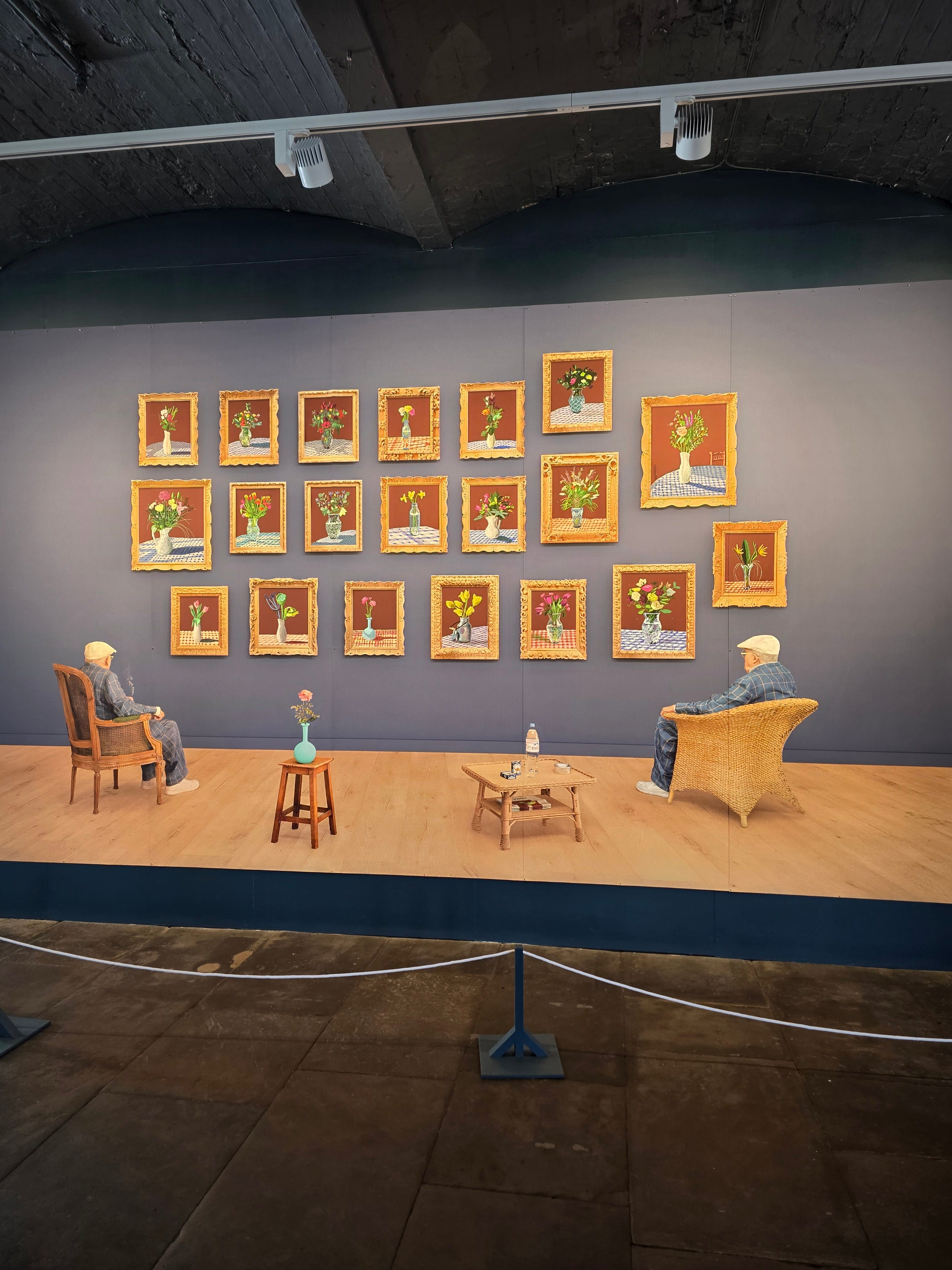
Here we have Looking at the Flowers (25th June 2022). What is remarkable in this painting is that everything but the flowers themselves are represented in 3D - a unique feature of Hockney's innovative “photographic drawings” technique. He pioneered this method whereby he walks around the object, takes many photos from different angles, and uses a software model to aggregate them into one 3D image.
I can attest that it works! As I approach the landscape, the chairs become almost tangible, as if they are figures in a toy set. The stool with the blue vase projects forward. The two Hockneys complement this immersive experience, and make you feel as if you are joining him (or should I say them!?) in this living room. In this sense, what we have is not a photograph, as a photograph merely captures an object at a single point in space-time, but rather a painting depicting our actual subjective experience of perspective which involves motion through space-time. Yet this experience arises from a combination of photographs depicting fixed objects.
Stare into this phenomenal invention long enough, and you soon realise that multiple perspectives are compatible with the same observed reality and underlying structure (an observation analogous to special relativity?)1. In this sense, the final product mirrors the very best Mondrian paintings. The value of the artwork is derived from the synthetic whole, yet that synthetic piece arises from a combination of smaller interchangeable pieces. Think of art conducted in this manner as a language. In neoplasticism, the letters or syllables are the lines, grids, and colours. Here it's the photographs of the same object from different angles themselves. The former sought precisely a universal language of art, hence a universal beauty, in the quest for a universal and immutable truth. The latter seeks to demonstrate (successfully) that the same universal reality can produce or be consistent with multiple perspectives. Nonetheless, the core theme, of universality and objectivity in beauty and truth, is looming as the elephant in the gallery.
A very Platonic vision of aesthetics arises. It's not enough to decompose the painting: the whole is the immutable object that beauty is derived from. Beauty is simply indivisible, as are all the forms. Beauty is a function of universal and objective reality, and so is itself universal and objective. From order, represented by a decomposible lattice of symbols (lines and grids in neoplasticism, photos in Hockney's work), you get the indivisible whole, and so increasing disorder is represented. In my view, the very best artworks encapsulate this increasing disorder after the final output. The second law of thermodynamics applies to art and beauty too, hence another reason for the Platonic vision of beauty!
By the way, here are some of the other exhibits. These same twenty flowers also appeared as single paintings, each framed individually:
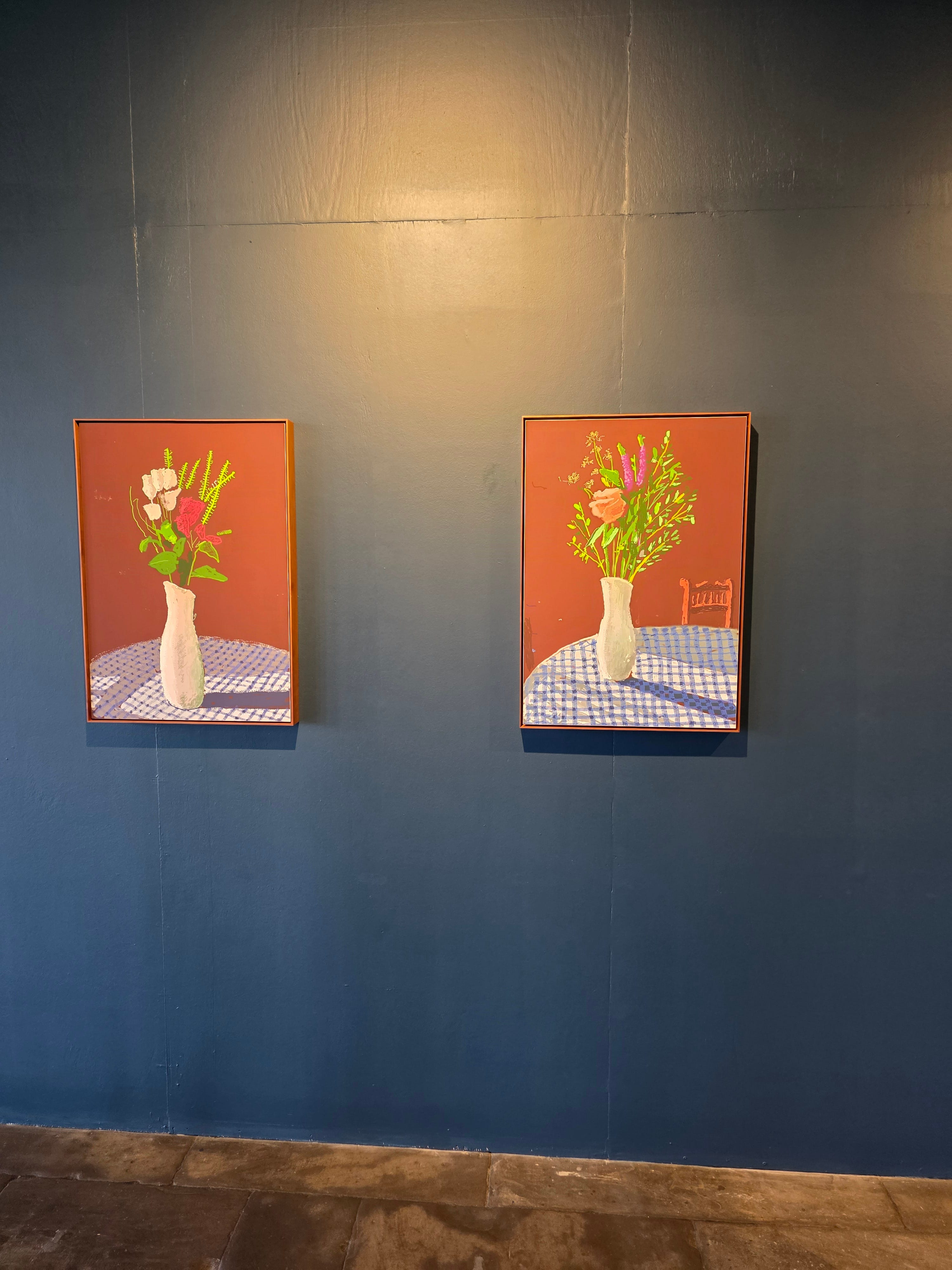
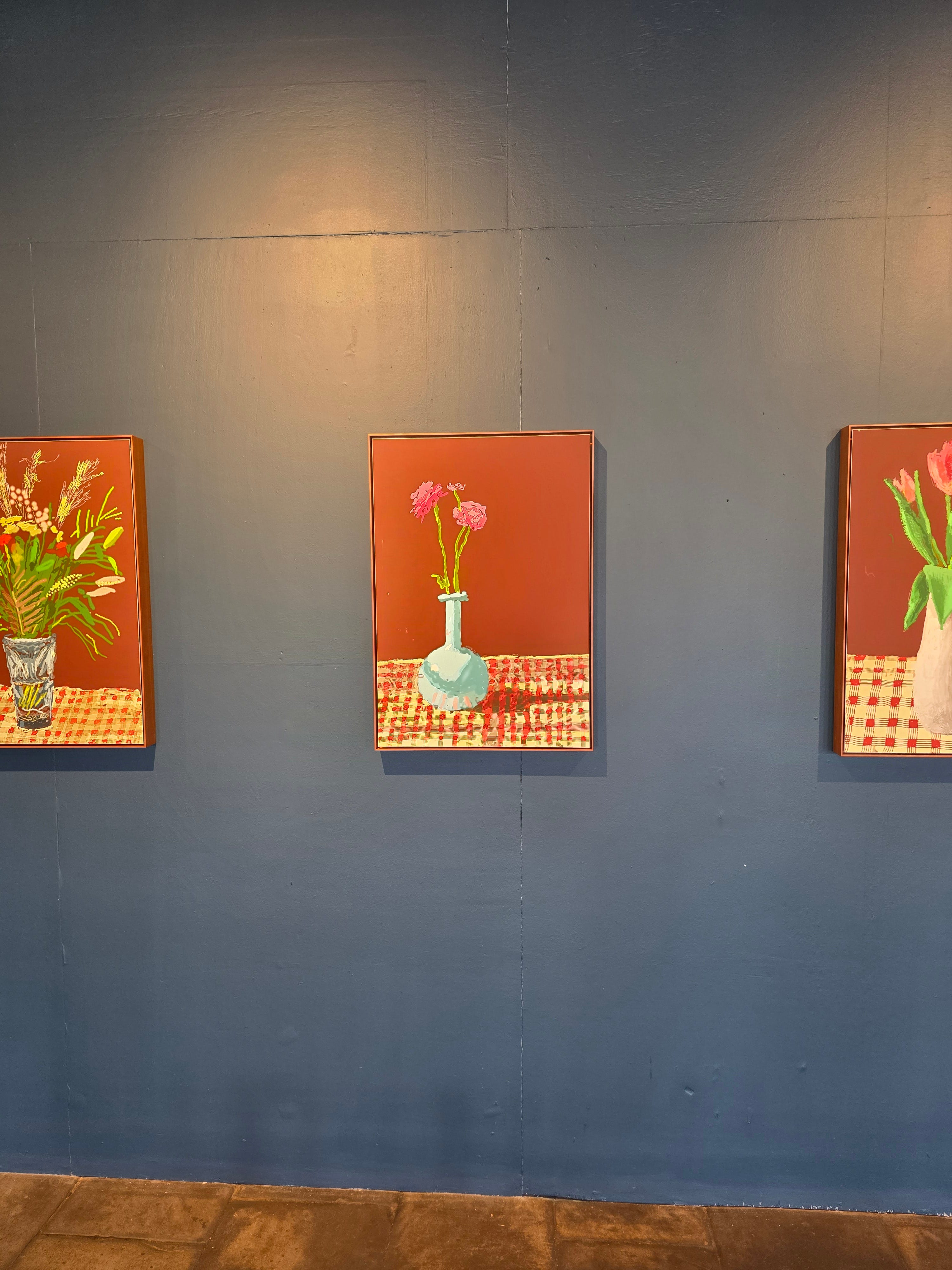
What I find particularly striking is the red background with the brownish hue. Or is it the reverse? Again this confirms Hockney's overrarching point on the same reality producing multiple perspectives.
Likewise, he has done a good job emphasising the flowers, vase, cloth, and even the shadow, as distinct objects. Each spring out at you, independently of the other. Yet without the other, the paintings are simply incomplete. He achieves this via his signature bright colours, which are again a necessary ingredient in generating the whole. Change the brightness or the colour even slightly, and the painting is discordant and loses harmony.
This is my favourite piece, inspired by Monet's lilies (below Hockney's), entitled Water Lilies in the Pond with Pots of Flowers (10th-22nd June 2021):
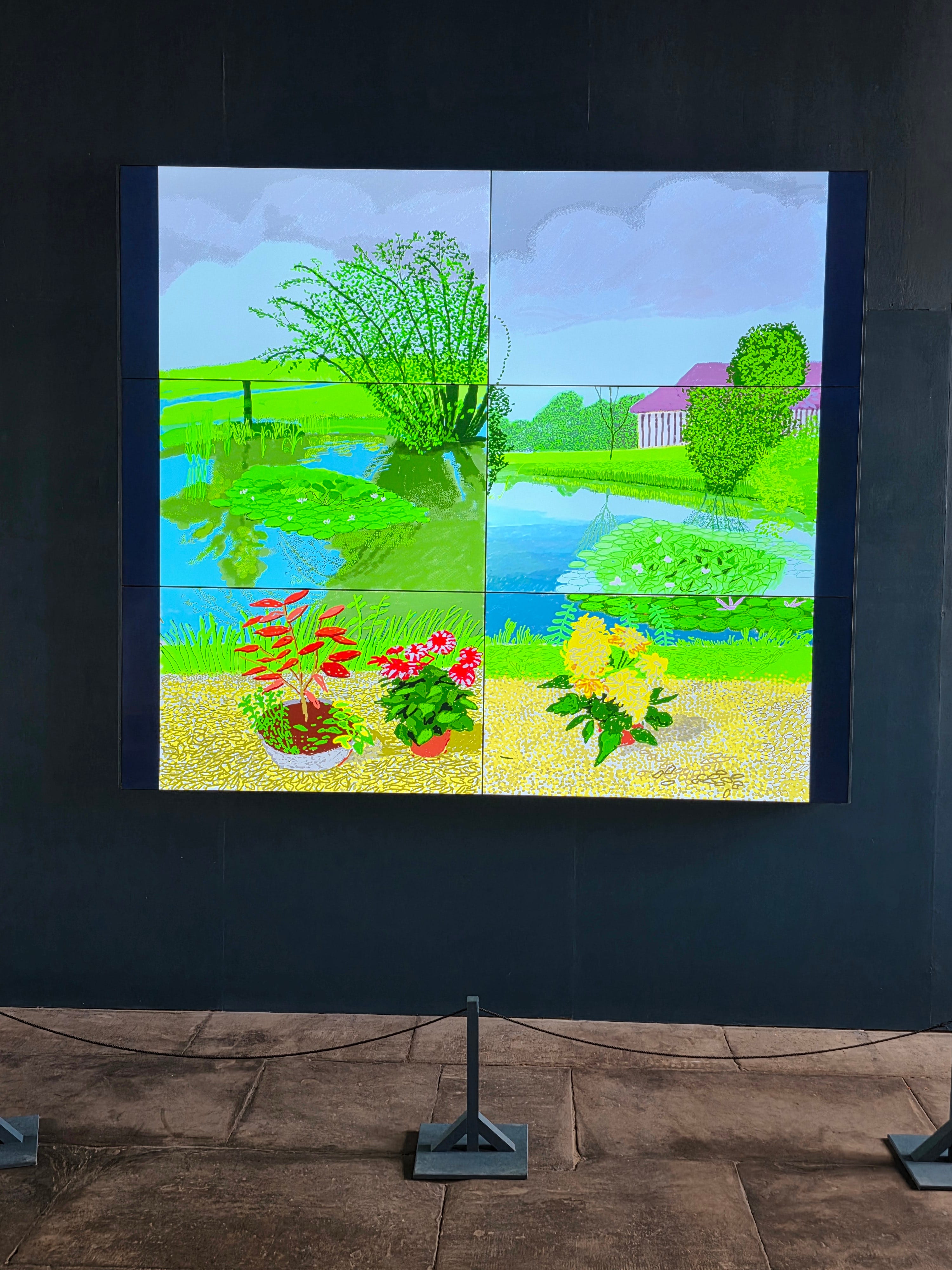
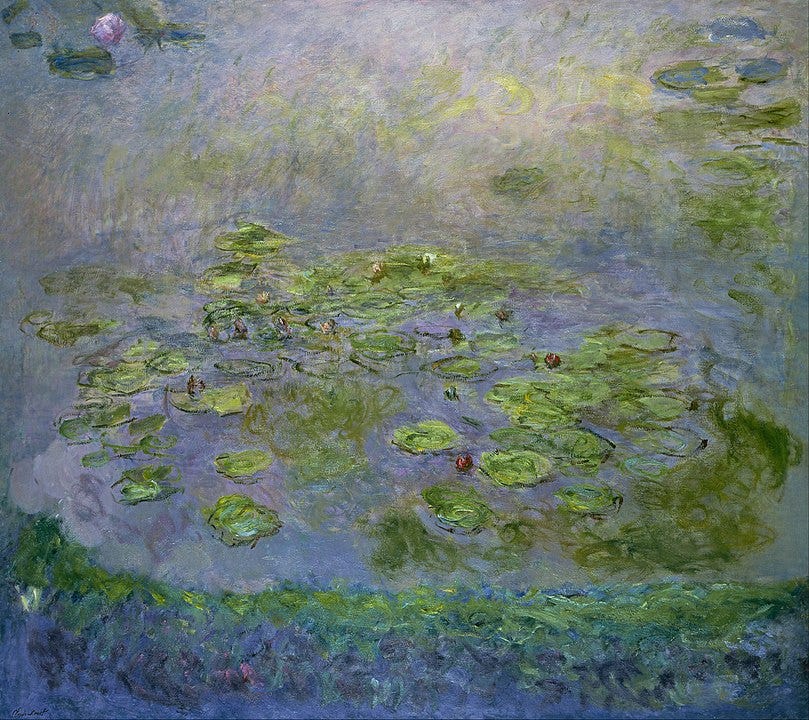
Hockney spent almost a fortnight creating this single piece, as six distinct drawings on an iPad. Who knew that such a resonating picture can be formed from a few strokes on a screen2? In his quintessential style, he attempts to replicate the perception of viewing the natural landscapes in real life. Although I find the frames clunky, they highlight that we're looking at six objects combined together rather than a single photograph captured instantaneously.
Of course, software algorithms were deployed to create the highlight of the exhibition, and that work was produced before the advent of LLMs or diffusion models. As in many fields, AI can be expected to complement rather than substitute human talent. AI-generated works per se tend to display an overtly “artificial” aura behind them; compromising their beauty. However, as artists on the frontier grapple with the expanded possibilities afforded to them (as Hockney did), we will find that (as with all technological advances) culture benefits as a result.
Ultimately, the genius of Hockney is that he deliberately shuns photographs, yet generates the same experience of perception, yet in real time and motion as opposed to a fixed capture. Everything, including the ubiquitous bright colours, is constructed immaculately to produce this phenomenon. As you gaze and ponder, you derive a sense of what it feels to see. The utility of art comes not just from the object itself, but in the entire act of viewing. Indeed, this is why you should visit more art galleries. You need to see these works in person to gain a full appreciation of their aesthetic qualities and beauty.
If you are in the West Yorkshire area, or anywhere in England3, you should come up to visit. Whilst Hockney's death adds poignancy, you get a unique first-hand experience of viewing the work of one of Britain's greatest artists of all time. What's more, all of this is free!
UPDATE (03/07/2026): I was thinking the other day that Hockney was inspired by Monet's impressionism, as one can see via the heavy emphasis on nature and bright colours. Yet does this somewhat undermine my Platonic argument? Impressionism was a seismic change to the art scene at the time, away from the grandeur of Renaissance themed works such as Raphael and DaVinci, and defenders of that old paradigm could have made the same argument regarding the Platonic objectivity of beauty. Here's Fable to tell you why this artistic innovation is actually more consistent with the forms than earlier movements.
Left open is the question of whether this holds vice-versa? If multiple configurations of “reality” are indeed compatible with the same perspective, then this adds weight to the Cartesian rationalists, and philosophies of mind emphasising subjective qualia.
Albeit the iPad introduces a sense of lighthearted warmth as opposed to the seriousness typically seen in master works
This trip can easily be done in a day from most locations in Northern England. I would say from elsewhere, it’s worth a night stay in a hotel just to visit this exhibition. Of course, you can combine such with sampling many other of our cultural delights (for instance Bradford's curry scene - the best Pakistani food outside Pakistan).